Guide
How to Manage Multiple Kids' Sports Schedules Without Losing Your Mind
If you are managing multiple kids' sports schedules, you already know the truth: the calendar does not stay tidy for long.
One kid has soccer practice. Another has a tournament. Someone needs to be at two fields at the same time. A schedule changes. A coach sends a last-minute update. Now you are trying to remember which child needs what, where, and when.
This is the real parent challenge in youth sports. It is not just about driving to practices. It is about keeping the whole family on the same page.
The good news is that you can make this a lot easier with a better system.
Start with one family calendar
If you are juggling kids activities, the first step is to stop relying on memory.
Use one calendar for:
- •Practices
- •Games
- •Tournaments
- •Pickup and drop-off times
- •Uniform days
- •Team events
- •Travel notes
If each kid has a different app, a different text thread, and a different paper note somewhere in the house, things will slip.
One view is better than five.
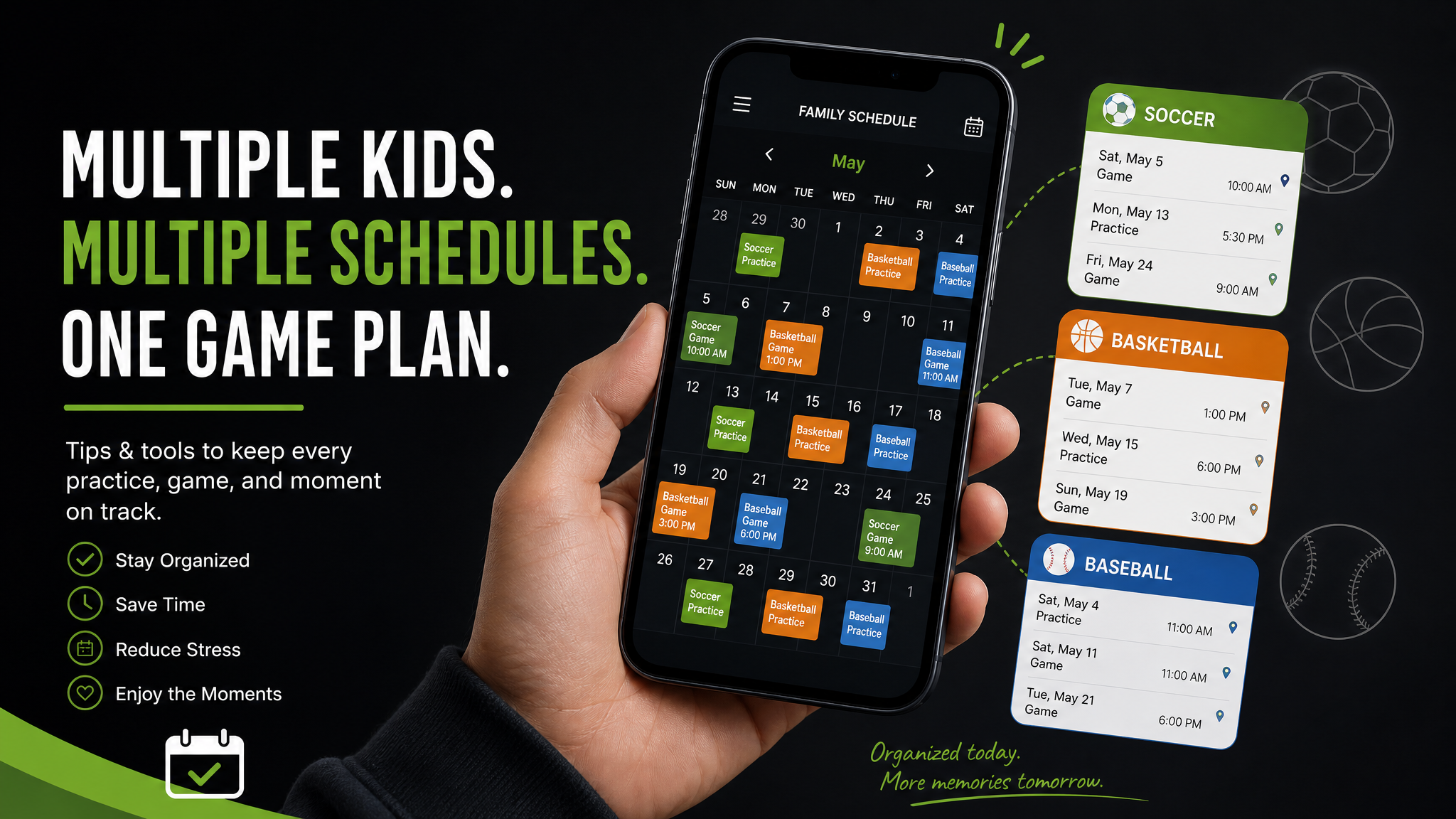
Color-code by child
This is a simple fix that helps a lot.
Assign each child a color and keep that color consistent across your schedule.
For example:
- •Blue for soccer
- •Green for baseball
- •Orange for basketball
That makes it much easier to scan the week and see where the pressure points are.
Put the real schedule in one place
A sports schedule for families works best when the source of truth is clear.
If a coach changes a practice time, you want that update in one place instead of buried in a text message.
That is where Squadline helps. It gives families one place to follow team schedules, chat, and updates, which matters a lot when one parent is tracking multiple teams across different kids.
See the scheduling feature and multi-team support.
Build a weekly review habit
The families who stay calm are usually the ones who review the week before it starts.
Pick one time each week, maybe Sunday night, and check:
- •Every practice
- •Every game
- •Any transportation conflicts
- •Equipment needs
- •Who is covering pickups
- •Any schedule changes
This takes 10 minutes and saves a lot of stress later.
Keep a family logistics list
In sports, a lot of the stress is not the sports part. It is the logistics.
Make a simple list of:
- •Who drops off each child
- •Who picks up each child
- •Which child has which gear
- •Which bags live in which car
- •Which days are the hardest
- •Which parents can help when needed
That way, the system is not only digital. It is practical.
Reduce the number of places you check
A big reason parents feel overwhelmed is that the information is spread out.
You check:
- •Text messages
- •Team apps
- •Paper flyers
- •Calendar reminders
- •Other parent messages
That is too much.
A better setup is to have one team app for each kid and one family calendar that pulls the important items together.
Use reminders for the hard days
Not every day is equally hard.
The days that usually cause problems are:
- •Doubleheader days
- •Tournament weekends
- •Rainout makeups
- •Carpool days
- •Early morning games
Set extra reminders for those.
The fewer decisions you have to make on the fly, the easier life gets.
Give each kid a home base
If you have multiple children in sports, each child should have a predictable system.
For example:
- •Their own equipment bag
- •Their own water bottle
- •Their own schedule view
- •Their own uniform checklist
This sounds small, but it cuts down on chaos fast.
Communicate with coaches early
When you are managing multiple schedules, it helps to be proactive.
If you know a conflict is coming up, tell the coach early.
That gives everyone more time to adjust and reduces the chance that a last-minute surprise turns into a bigger issue.
Good communication helps your family and the team.
What not to do
Here are a few habits that make things worse:
Do not rely on memory
You will forget something eventually.
Do not keep schedule info in different apps without a system
That creates confusion fast.
Do not assume everyone knows the latest change
They probably do not.
Do not overcomplicate the family calendar
Keep it readable.
Why multi-team management matters
If you are one of those parents with multiple kids in sports, you are not just managing one team. You are managing several moving parts at once.
That is why Squadline’s multi-team support is useful. It helps families keep up with more than one child, more than one team, and more than one schedule without losing track of the basics.
Instead of bouncing between systems, you get a simpler view of what matters.
Explore:
A simple weekly system that works
If you want a practical routine, try this:
- •Sunday: review the whole week
- •Each morning: check for schedule changes
- •Before each practice: confirm time and location
- •Before each game: confirm gear and arrival time
- •After each update: move the info into your family calendar
It is not fancy. It works.
Final thoughts
Managing multiple kids' sports schedules is hard because the load is real. You are not imagining it.
The best solution is not more stress or more guessing. It is a clearer system.
If you keep one family calendar, reduce the number of places you check, and use a team app that keeps updates in one place, life gets easier.
Squadline is built to help families do exactly that.
Make transportation its own system
The schedule is only half the battle. The other half is getting everyone where they need to go.
Create a simple transportation plan for:
- •Who drives which child
- •Which parent handles which pickup
- •Which days require carpool help
- •Which fields are harder to reach
- •Which games need extra travel time
That reduces last-minute panic.
Keep a “sports bag” checklist
A forgotten shin guard or water bottle can create a bigger headache than it should.
Put together a repeatable checklist:
- •Uniform
- •Cleats
- •Socks
- •Water bottle
- •Snack
- •Extra layer
- •Equipment specific to the sport
Keep it by the door if you can.
Teach kids to own part of the process
If your kids are old enough, they can help.
They can:
- •Pack their own gear
- •Check the schedule
- •Remind you about game times
- •Keep their uniforms together
That does not solve everything, but it lowers the load.
Make peace with imperfect weeks
Some weeks will still be messy.
That is normal.
The goal is not a flawless calendar. The goal is a system that keeps the chaos manageable when life gets busy.
If you can do that, you are already doing better than most.
A final sanity check for busy parents
Before the week starts, ask:
- •Do I know where every child needs to be?
- •Do I know who is driving?
- •Do I know which gear is needed?
- •Do I know about any schedule changes?
- •Do I know where to look if something changes?
If the answer is yes, you are in good shape.
Closing thought
The goal is not to eliminate the chaos of family life. It is to stop the schedule from controlling your whole day.
Make changes visible fast
When a coach changes the schedule, the update should be impossible to miss.
That means one place, one alert, and one family calendar update. The faster the change is visible, the less chaos you deal with later.
One last tip: leave buffer time
A ten-minute buffer before and after practices can save a lot of stress. It gives you room for traffic, gear, sibling handoffs, and the small surprises that always show up.
A realistic mindset helps too
The busiest families do not win by being perfectly organized. They win by being clear about the next step. If you know what is happening today and tomorrow, and you have one place to check for changes, the rest gets easier to manage.
Make the system visible to the whole household
The more adults who can see the same schedule, the fewer surprises you have. Share the same calendar with anyone involved in pickups, travel, or gear prep so the plan does not live in one parent’s head.
Final tip
When in doubt, simplify the plan instead of adding another layer. Simpler systems are easier to keep up with, and that matters most when the week gets busy.
Ready to simplify your season?
Download Squadline free and get your team organized in under 5 minutes.